The Donner N-32 MIDI keyboard review is a useful starting point for players who want a compact controller for learning, sketching arrangements, or adding keyboard input to a computer or mobile music setup.
Its 32 velocity-sensitive keys, built-in performance controls, and included teaching courses make it more than a bare-bones travel keyboard, though it still needs compatible software to produce sound.
Donner N-32 Review Summary
The quick verdict
500+ ratings
Read Amazon ReviewsDonner N-32 MIDI Keyboard
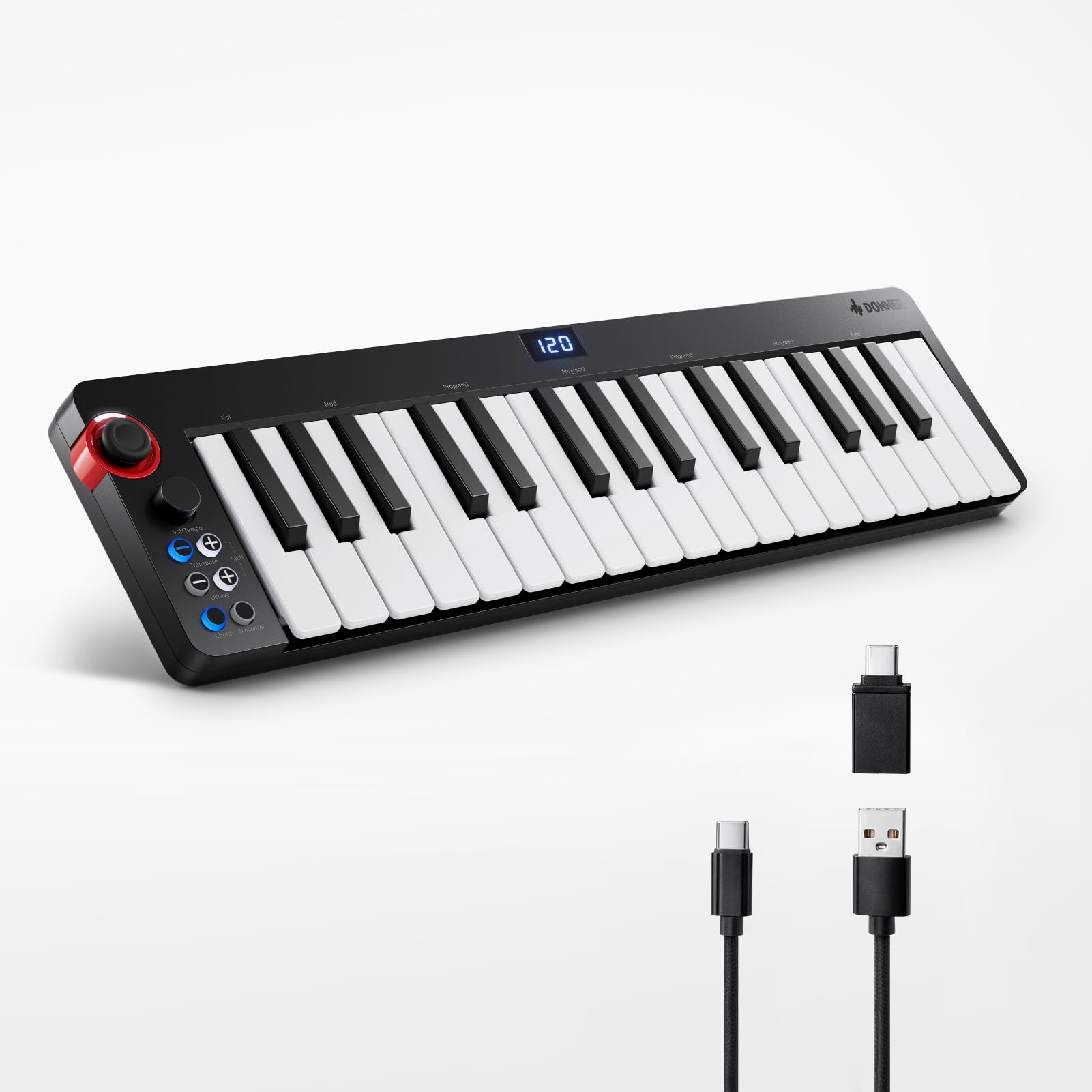
A portable 32-key MIDI controller for beginners and mobile producers who want expressive keys, onboard controls, and lessons in a small setup.
- 32 scaled-down, velocity-sensitive keys for expressive MIDI note input.
- A digital display and four customizable banks for organizing controller functions.
- Chord arpeggiator, octave, pitch-shifting, sequencer, and sustain-pedal support.
- A light-up control wheel provides pitch-bend and modulation control.

Pros
- Compact and lightweight design is practical for small desks and mobile music-making.
- Velocity sensitivity and pitch/modulation controls offer more expressive input than a basic note-entry controller.
Consider before buying
- The 32-key layout offers less range than a full-size keyboard, so broader piano parts may require octave changes or another controller.
- It does not produce sound on its own; plan to use a compatible DAW or music editor app.
Read the full review summary
The N-32 combines a 32-key scaled-down keyboard with a digital display, four customizable banks, and controls for octave, pitch, chords, arpeggiation, sequencing, and sustain-pedal use.
Its compact dimensions and one-pound weight suit a desk with limited room or a kit that moves between locations, while USB-MIDI connectivity gives it a straightforward route into supported music software and mobile editor apps.
This controller is aimed at people who want to enter notes and shape performances rather than play a full-size piano directly.
The smaller key range can work well for melodies, bass lines, and compact arrangements, and velocity sensitivity gives note input more expressive potential.
Beginners may also appreciate the 40 teaching courses, while experienced users can map controls through four banks. Remember that the keyboard itself does not make sound: a compatible DAW or music app is part of the setup.
The buying factors
Donner N-32 Scorecard
Editorial scores reflect listed features and buyer fit; they are not laboratory measurements or customer ratings.
Portability
At one pound and about 16.7 inches wide, it is designed to fit easily into a compact workspace or travel setup.
Key range
Thirty-two scaled-down keys are convenient for compact parts, but the range is limited for two-handed piano playing.
Expressive control
Velocity-sensitive keys plus pitch bend and modulation provide several ways to vary a performance.
Hands-on features
The listed octave, chord, arpeggiator, sequencer, and sustain-pedal functions cover a broad set of basic controller tasks.
Beginner support
The package includes 40 keyboard-teaching courses, alongside a simple layout intended to be approachable.
Setup flexibility
USB-MIDI compatibility spans computer and mobile platforms, with supported DAWs and music editor apps.
Key Features and Specifications of Donner N-32
- 32 scaled-down, velocity-sensitive keys for expressive MIDI note input.
- A digital display and four customizable banks for organizing controller functions.
- Chord arpeggiator, octave, pitch-shifting, sequencer, and sustain-pedal support.
- A light-up control wheel provides pitch-bend and modulation control.
- USB-MIDI connection; the keyboard is listed as compatible with Mac, Windows, iOS, and Android.
- Includes a Type-C cable, manual, music-production software, and 40 teaching courses.
Pros and Cons of Donner N-32
Pros
- Compact and lightweight design is practical for small desks and mobile music-making.
- Velocity sensitivity and pitch/modulation controls offer more expressive input than a basic note-entry controller.
- A useful selection of musical functions is built into the controller, including chord and sequencing tools.
- The included 40 courses may give new keyboard learners a structured way to get started.
Consider before buying
- The 32-key layout offers less range than a full-size keyboard, so broader piano parts may require octave changes or another controller.
- It does not produce sound on its own; plan to use a compatible DAW or music editor app.
- Mobile setup may depend on the device and app connection method, so check your phone or tablet’s port and adapter needs before buying.
Who Should Buy Donner N-32?
Good fit
Consider the N-32 if you want a small MIDI keyboard for entering melodies, bass lines, chords, or short arrangements in a DAW.
Velocity-sensitive keys and the pitch/modulation wheel give performances room for variation, while the octave and chord tools can help when you are working within a limited key range.
The light-up wheel also makes its expressive controls easier to see while playing.
It is a particularly plausible fit for a beginner who wants to learn keyboard basics and experiment with music production in the same compact setup.
The 40 teaching courses add a learning component, and the four customizable banks give you a way to arrange controller functions as your workflow develops.
Before purchasing, make sure your preferred software is compatible and that you have a way to monitor the sound generated by your DAW or app.
For a portable home or travel rig, the low weight and modest footprint are useful advantages.
If your compositions frequently need a wider piano range, check whether the 32 scaled-down keys will feel comfortable for your playing style; the controller is best approached as a compact input surface, rather than a substitute for a full-range keyboard.
Who should skip it
Skip this model if you need a full-range keyboard for extended two-handed piano practice or performance. Its 32-key layout is intentionally compact, and frequent octave changes may interrupt that kind of playing.
It is also a poor fit if you expect a standalone instrument with built-in sounds. The N-32 sends MIDI data, so you will need compatible music software or an app to hear its notes.
Donner N-32 MIDI Keyboard Review: What Its Compact Design Means
A compact keybed for focused parts
Thirty-two scaled-down keys make the N-32 easier to place in a small workspace and more convenient to carry than a broad keyboard. That format naturally suits focused parts such as melodies, bass, and short chord figures.
Players who rely on a wide span of notes should consider how often they would need to switch octaves, since the available key range shapes how comfortably they can perform.
More than note entry
The controller includes octave, pitch-shifting, chord arpeggiator, sequencer, and sustain-pedal functions. Together, those controls can support quick idea generation without requiring every musical gesture to come from the keys.
Four customizable banks add room to organize functions, which may help users who want to adapt the layout to different tasks or software instruments.
Expressive controls and visual cues
Velocity sensitivity lets the keyboard communicate differences in how notes are played, while pitch bend and modulation offer additional performance gestures. The light-up wheel gives those controls a visible focal point.
These features are useful for shaping MIDI performances, but the resulting sound and response will also depend on the instrument or DAW receiving the input.
Software is part of the instrument setup
USB-MIDI support is listed for Mac, Windows, iOS, and Android, with compatibility across several major DAWs and mobile music-editor apps.
The keyboard needs software to generate sound, so compatibility is a practical buying check rather than a minor setup detail.
Confirm that your preferred app recognizes MIDI input and that the cable or adapter arrangement fits your device before relying on a mobile workflow.
Alternatives to Donner N-32
One useful alternative is included because the supplied options contain a pad controller for a distinct but related music-production workflow.
Computer Recording MIDI Controllers alternative
400+ ratings
Read Amazon ReviewsDonner STARRYPAD MIDI Pad Controller
Choose the N-32 if playing notes on a compact keyboard is central to your workflow.
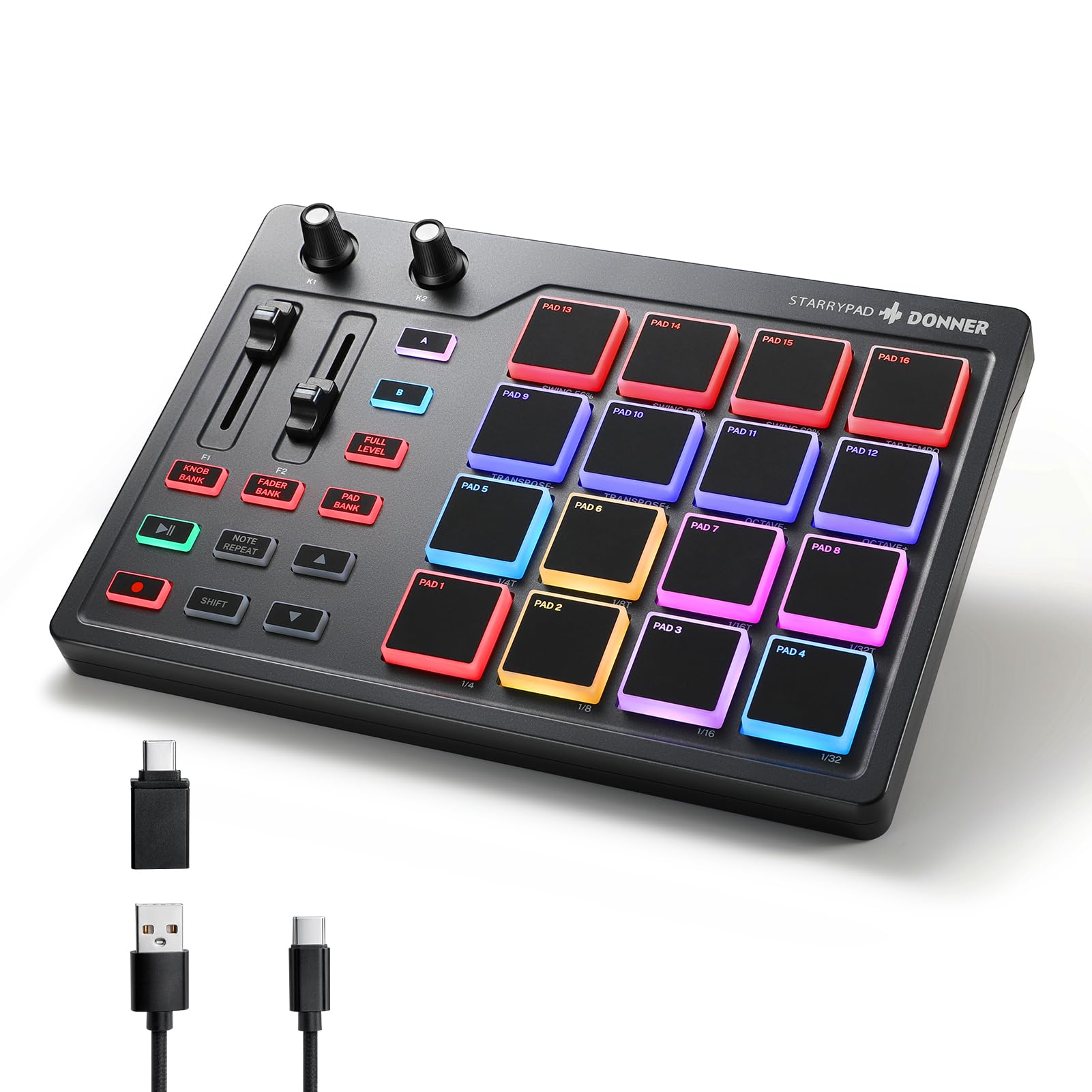
The STARRYPAD is a closer match for finger-drumming, triggering samples, and controlling a DAW with pads and assignable faders or knobs; its different playing surface makes it a complementary option rather than a keyboard substitute.
- The STARRYPAD uses 16 backlit silicone pads, switchable banks for up to 48 assignable pads, and adds two faders, two knobs, and three buttons.
- It also lists Tap Tempo, Note Repeat, MIDI in/out, and included Melodics courses and Cubase LE software.
- The N-32 is centered on 32 velocity-sensitive keyboard keys, with controls for keyboard-oriented parts such as octave, chords, and sustain.
Is Donner N-32 Worth It?
The Donner N-32 is worth considering if you want a light, compact MIDI keyboard with expressive keys, useful performance controls, and beginner-oriented lessons.
Its strengths are the combination of portability and hands-on music functions, plus support for computer and mobile workflows.
Buy it if 32 scaled-down keys suit the parts you plan to play and you already have, or intend to use, compatible music software.
Look elsewhere if you need a broad piano range or a standalone sound-making keyboard; those needs do not match the N-32’s compact MIDI-controller design.
Your review at a glance
500+ ratings
Read Amazon ReviewsDonner N-32 MIDI Keyboard
A portable 32-key MIDI controller for beginners and mobile producers who want expressive keys, onboard controls, and lessons in a small setup.
- 32 scaled-down, velocity-sensitive keys for expressive MIDI note input.
- A digital display and four customizable banks for organizing controller functions.
- Chord arpeggiator, octave, pitch-shifting, sequencer, and sustain-pedal support.
- A light-up control wheel provides pitch-bend and modulation control.